The watch which sailed with Charles Darwin
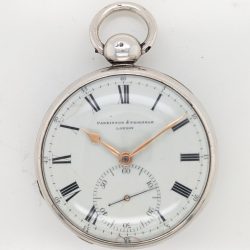
An Historically Important Pocket Chronometer
Present on the Second Voyage of HMS Beagle
Accompanied Charles Darwin around the world from 1831 to 1836 and ashore to the Galapagos Islands.
The most significant of the chronometers surviving from the voyage.
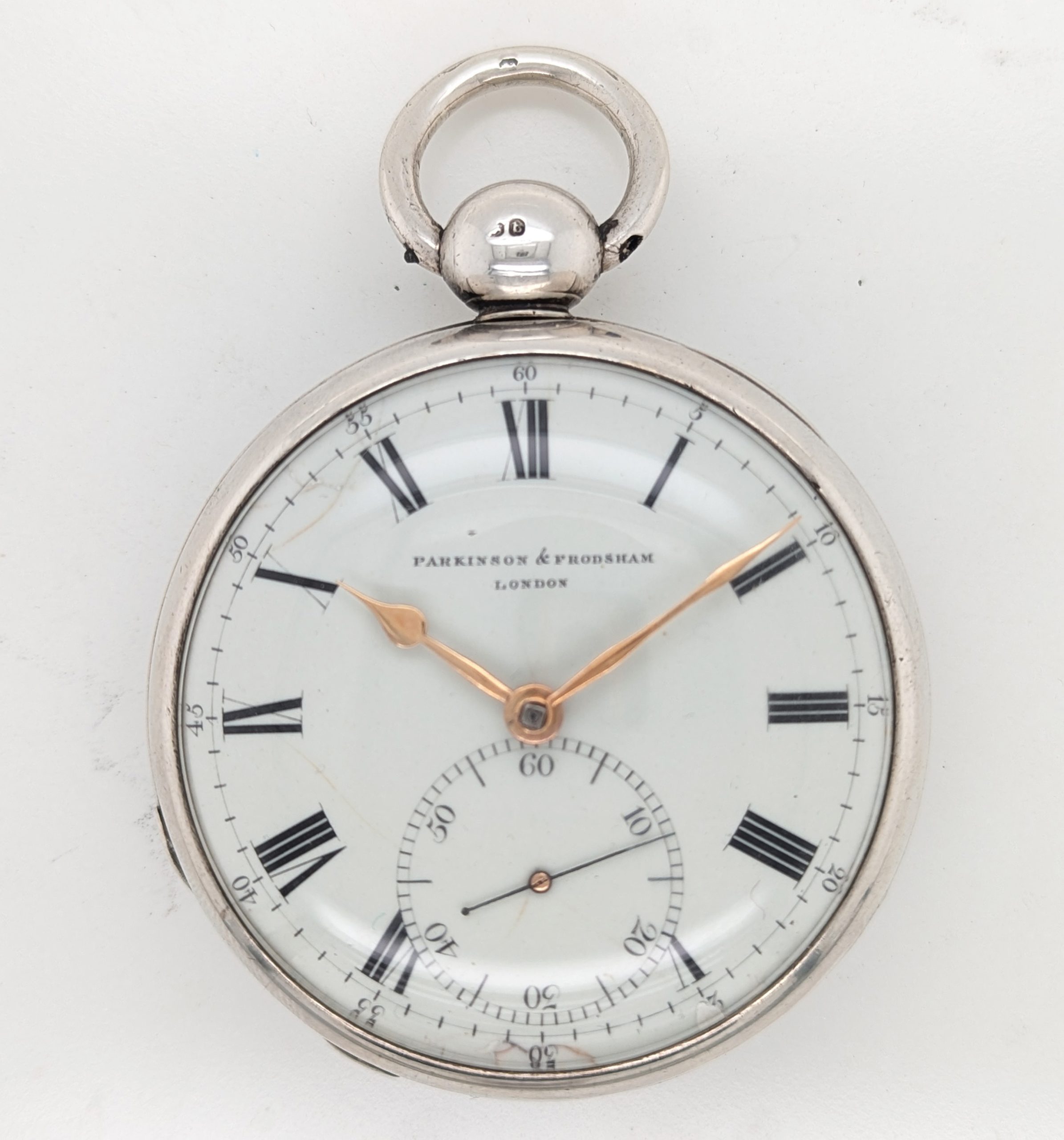
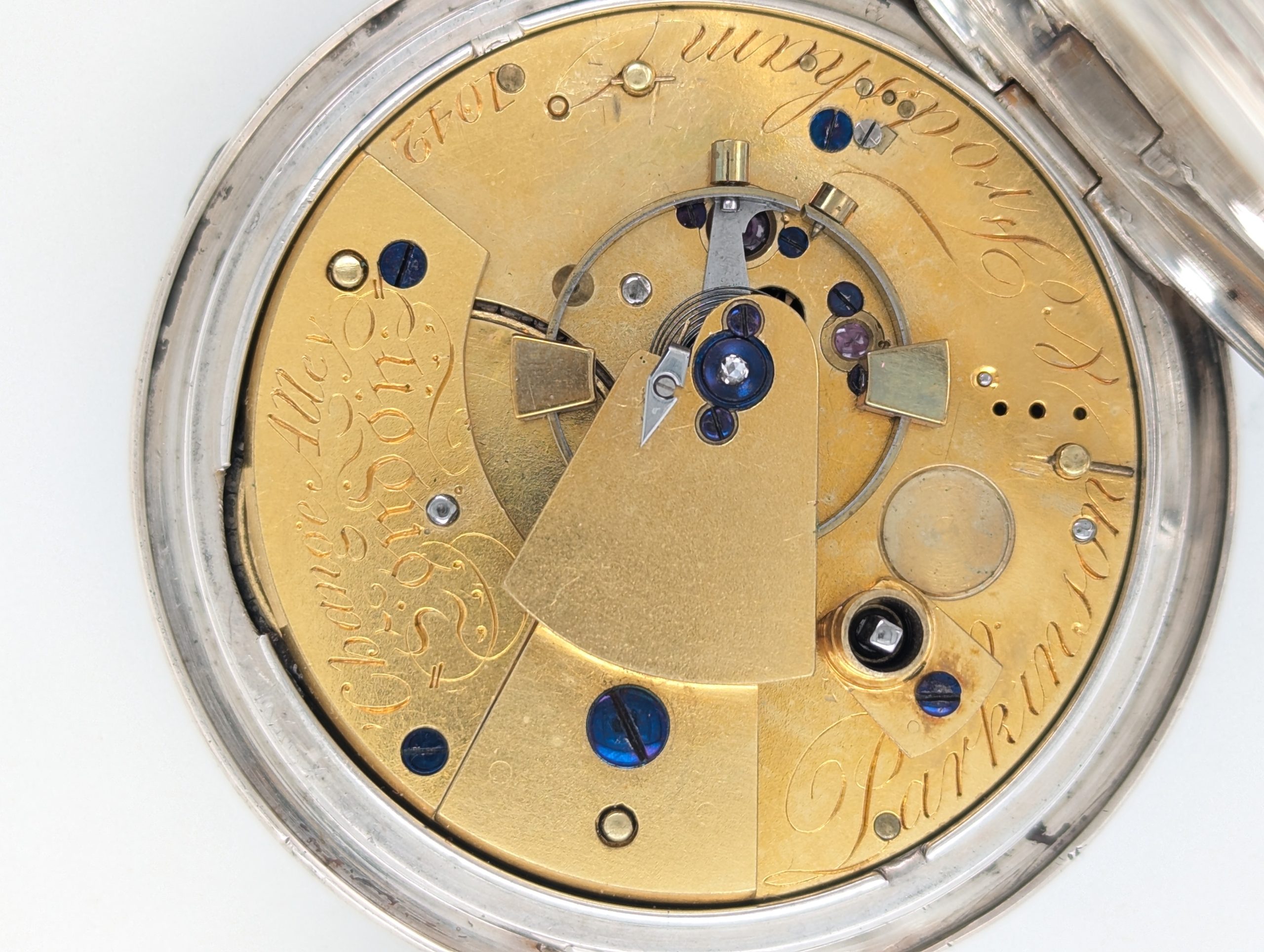
An early 19th Century English chronometer by Parkinson & Frodsham. Full plate gilt keywind fusee movement, dust collar to the fusee square next to a machined circular depression in the plate. Harrison’s maintaining power. Plain cock with diamond endstone in a blue steel setting. Large compensation balance with two wedge shaped weights and timing nuts, freesprung blue steel overcoil hairspring. Earnshaw type spring detent chronometer escapement. Screwed in jewelling, escape pivots with endstones. With machined circular depression[1].
Signed white enamel dial with subsidiary seconds, Roman and Arabic numerals, fine blue steel seconds hand with a gold arbor, gold hands.
Signed Parkinson & Frodsham, Change Alley, London, and numbered 1042. In a plain silver open face consular case by Thomas Gibbard, London 1817[2]. In a mahogany deck box.
Diameter: 2 ¼ inches / 55 mm.
In 2024, I re-identified a pocket chronometer used in December 1831 on HMS Beagle, under the command of Captain Robert Fitzroy, when the ship sailed on a second voyage to complete a survey of the coast of South America and to establish a chain of longitude calculations around the globe. Purchased by the nation, Chronometer K will go on display at the National Maritime Museum, Greenwich in October 2026.
Before Beagle departed Devonport, no fewer than twenty two chronometers were embarked, to guard against redundancy during the long voyage. Nineteen were box chronometers and three―including this example―were pocket chronometers. As Darwin reported ‛No vessel ever left England with such a set of Chronometers, viz 24 (sic), all very good ones.’[3]
Five years later, twenty chronometers would return to England, two having been gifted meantime to the Chilean and Peruvian governments by Fitzroy. In a phenomenal feat of timekeeping and despite enduring a voyage of tens of thousands of miles in all weather conditions, back in London the chronometers recorded an error of just 33 seconds from local time, the equivalent of 8 nautical miles,.
In his published table of the chronometers, Captain Fitzroy classifies Parkinson & Frodsham No. 1042, which was issued to Beagle by the Admiralty, as timekeeper ‘K’, further noting that it was ‛Good’.[4] Except for the pocket types, each of the chronometers was suspended on gimbals in its own box planted in sawdust on partitioned shelves in a small, dedicated cabin low in the ship. Access to the cabin was restricted to George Stebbing, an instrument maker hired by Captain Fitzroy solely to maintain the chronometers for the duration of the voyage.
‛K’ was selected as the voyage’s journeyman chronometer, ‛carried by hand, in a box’, which Fitzroy recalled ‛was always used for taking time.’
In every instance, it was compared with the standard chronometers (the two supposed to be the best) immediately before the morning observation, and again immediately afterwards. It was also compared at noon, and before, as well as after the afternoon, observations. This watch was so well constructed, that the intervals shown by it between morning and afternoon observations always agreed with those shown by the standards, (allowing for their respective rates).[5]
Unlike the other chronometers, most of which remained in situ in their purpose built cabin, ‛K’ was likely situated on deck in air temperature to reduce fluctuation with the conditions below. As Beagle’s Daily Chronometer Rates Book shows, throughout the voyage ‛K’ was also taken ashore in the ship’s boat to accompany the shore party, which usually included Fitzroy’s naturalist Charles Darwin. On each occasion, such as landing on the Galapagos Islands in September 1835, the book records how the time shown by ‛K’ was taken and recorded before
‛Going‛, and again when ‛Returning’ to the ship. The book also reveals that the chronometer went ashore for four days at Valparaiso to be cleaned.[6]
Following it’s return to England, Parkinson & Frodsham No. 1042 continued in Admiralty service until it was eventually exchanged out of government ownership for new timepieces in 1906. Recently re-identified, it is the most significant of the eight chronometers surviving from the voyage of the Beagle.
Service history of Parkinson & Frodsham 1042.
| 13 August 1831 | HMS Beagle, Captain Fitzroy |
| 4 April 1837 | Fairy sloop |
| 24 December 1838 | Acheron |
| 23 June 1842 | Philomel |
| 26 December 1846 | HMS Albatross |
| 10 May 1852 | HMS Herald, Captain Denham, to survey the coast of Australia and the Fiji Islands. |
| 26 June 1862 | HMS Rapid, Commander Jago |
| 24 October 1876 | Captain Charles Warren, R.E., for survey work in South Africa. |
| 17 October 1882 | Transit of Venus Expedition to Bermuda |
| 26 March 1884 | HMS Triton to survey the coast of England. |
| 27 April 1892 | James Poole & Co., chronometer manufacturers of Clerkenwell, for servicing. |
| 5 July 1892 | Noted ‛Not worth repair’. |
| 12 June 1902 | HMS Blake |
| 16 May 1906 | HMS Warspite |
| 27 August 1906 | HMS Euryalus |
| Taken in exchange by E.Dent & Co. for new Hack watches. | |
| Private Collection |
.
Seven other chronometers are known to survive from the second voyage of HMS Beagle:
- ‛F’: box chronometer No.661 by Arnold & Dent (private collection)
- ‛M’: box Chronometer No. 2 by William Edward Frodsham (sold Bonhams, London, July 2014, £74,500)
- ‛N’: box chronometer No. 1175 by Robert Molyneaux (sold Bonhams, London, December 2014, £100,900)
- ‛O’: box chronometer No.705 by Thomas Earnshaw (Science Museum, London)
- ‛P‛: box chronometer No. 1 by William Edward Frodsham (private collection)
- ‛V’: box chronometer No. 426 by Robert Pennington (British Museum, London)
- ‛X’: box chronometer No. 509 by Thomas Earnshaw (British Museum, London)
[1] To remove Admiralty arrow mark on exchange.
[2] Thomas Gibbard, watch case maker of 28, Clerkenwell Close.
[3] Charles Darwin to J S Henslow, 15 November 1831, Darwin Correspondence Project, “Letter no. 147,” accessed on 22 November 2024, https://www.darwinproject.ac.uk/letter/?docId=letters/DCP-LETT-147.xml.
[4] Narrative of the of the Surveying Voyages of His Majesty’s Ships Adventure and Beagle, Appendix to Volume II. (London, 1839), p.325.
[5] Ibid. p. 329.
[6] UKHO: OD 807 Entries for 16 & 22 June 1835.