Queen Caroline’s Coffin Plate
‛They have destroyed me, but I forgive them’
The extraordinary story of the coffin plate of Caroline of Brunswick, Queen of England
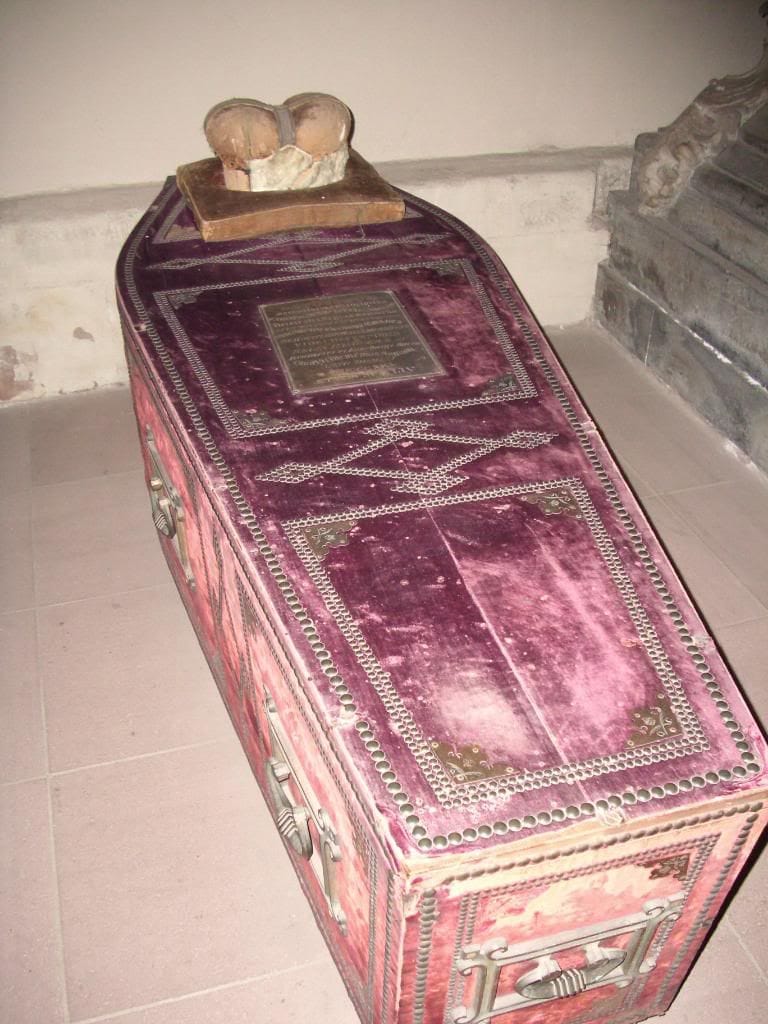
Early on the morning of 14 August 1821 a mournful procession of carriages, one carrying a crown, and headed by a troop of cavalry passed through a throng of people at the gates of Brandenburgh House in Hammersmith. The carriages accompanied a hearse drawn by eight black horses which rattled through the gates to the sounds of a muffled church bell tolling and a minute gun firing from across the Thames. The hearse conveyed a short, crimson velvet covered lead lined coffin richly embellished with gilt ornament but, unusually, without a coffin plate to identify its occupant. This had been removed by the deceased’s executors the evening before although they had been prevented, by order of the Lord Chamberlain, from attaching in its place a silver coffin plate they had secretly prepared. However, none was needed for the thousands of people standing in the rain on the route into London, in scenes not to be repeated until the death of Princess Diana in 1997. They had come to pay their respects, and often to noisily support, their dead queen Caroline and to show their hostility to her treatment at the hands of their new king, George IV.
Born in 1768, Caroline was the daughter of Charles II, duke of Brunswick, and Princess Augusta, a sister of King George III. In 1795, Caroline had been selected by the king to marry his wayward eldest son George, prince of Wales and to force a separation between George and his longstanding mistress Mrs Fitzherbert. The marriage was not a success. Caroline objected to her husband’s philandering and drunken antics whilst he complained that she was fat and smelled. The couple parted after just ten months of marriage which nevertheless produced a daughter, Princess Charlotte (1796-1817) who, as heir to her father, was from birth second in line to the throne.
Always high-spirited and strong-minded, Caroline left the palace after Charlotte was born to set up a separate household at Blackheath from where rumours of her various love affairs, even of an illegitimate child, led to a ‛delicate investigation’ into her lifestyle. Prevented by George from seeing her daughter―who was kept under strict supervision at court― Caroline left England to live a peripatetic existence on the Continent. As a future Queen of England, and mother to another, she was closely watched all the time by her husband’s spies who salaciously reported her wayward behaviour and relationships with various men, notably with Bartolomeo Bergami, her Milanese factotum and intimate companion.
Unable to divorce his wife―not least because any proceedings would expose his own serial adultery―George gathered evidence against Caroline to force an annulment by act of parliament. As soon as he became king in January 1820 George compelled the government to introduce a bill in parliament to achieve his goal. On her return to England to claim her rightful crown as queen, Caroline was instead subjected to a ‛trial’ in the House of Lords which she attended in person. The king’s vendetta against his wife and his own misconduct was deplored by the public who gave Caroline their overwhelming support and sympathy adopting her as the figurehead for a rising tide of radical, anti-government opinion. Fearing disorder even revolution, the government dropped the bill and, instead, offered Caroline a generous pension to live abroad.
However, the king could not be persuaded to allow Caroline to be crowned queen. Undeterred, she went to Westminster Abbey for the coronation on 20 July 1821 and demanded to be admitted shouting at the sentries ‛Let me pass, I am your Queen’. Her entry barred, Caroline eventually retreated disconsolately to her residence at Brandenburgh House where shortly after she fell dangerously ill with a blockage in her bowel. Calmly resigned to her fate, Caroline summoned her executors to her bedside to make her final will telling them ‛They have destroyed me, but I forgive them. I die in peace with all mankind.’ Afterwards she recalled her closest aide Dr Stephen Lushington to give further instruction that she wished to be buried in Brunswick and ‛that the inscription upon my Coffin be “Here lies Caroline of Brunswick the injured Queen of England”’.
Five days later, on the evening of 7 August, Caroline’s turbulent life ended, freeing the king from his ill-starred marriage but not from the opprobrium of the public for his behaviour towards her.
The government willingly agreed, and paid for, Caroline’s body to be shipped to Brunswick but the prime minister Lord Liverpool, acting on instruction from the Lord Chamberlain’s Office, insisted that the coffin’s plate be inscribed according to royal protocol, and in Latin. The approved plate celebrated the king more than it commemorated Caroline:
|
DEPOSITUM Serenisimæ Principilsæ CAROLINÆ AMELIÆ ELIZABETHÆ Dei Gratia Reginæ Consortis AUGUSTISSIMI ET POTENTISSIMI MONARCHÆ GEORGII QUARTI DEI GRATIA BRITANNIAURUM REGIS FIDEI DEFENSORIS REGIS HANOVARÆ AC Brunsvici et Luneburgi Ducis Obit VII Die mensis Augusti ANNO DOMINI MDCCCXXI ÆTATIS SUÆ LIV
|
(Translation)
Deposited The Most Serene Princess Caroline Amelia Elizabeth By the Grace of God Queen Consort Of the Most August and Powerful Monarch George the Fourth By the Grace of God, King of Britain Defender of the Faith King of Hanover and Duke of Brunswick and Luneburg Died the 7th Day of August In the Year of the Lord 1821 Aged 54 |
Undeterred, Lushington, a radical lawyer and politician who had acted for Lady Byron in her recent separation from her poet husband, was determined to honour Caroline’s final wishes. An order was sent to silversmith Paul Storr in Gray’s Inn Road to make a large silver coffin plate at the cost of £25 17s. 3d. Storr worked quickly, as the plate was ready and engraved according to the queen’s instructions by 13 August, just six days after she died. However, told by government he could not fix it to the coffin ‛while the body is under the jurisdiction of this country’, Lushington instead removed the official Latin version from the coffin leaving it bare, reasoning that the body remained in the care of the executors and not of the country whilst it rested in the marble saloon at Brandenburgh House. And so, in this unnamed condition, the coffin began its long journey to Germany.
The government had wanted Caroline’s funeral procession to avoid the City of London and the risk of demonstrations by her supporters, known as Queenites. But at Kensington Church the road north to Islington was blocked by carts forcing the procession, now joined by a troop of Life Guards, through Knightsbridge. At Hyde Park Corner more barricades had been thrown up which the guards forced leading the carriages into the park pursued by Queenites, many now throwing stones and bricks. Amid the confusion, several people were wounded and two men killed in scenes that were bitterly reminiscent of the Peterloo Massacre just two years earlier. Eventually the colonel of Life Guards read the Riot Act and some order was restored and the procession resumed. However, at Tottenham Court Road the cortège again met a barrier of chained carts and unable to continue away from London it was instead pushed towards the city escorted now by jubilant crowds many carrying banners with radical slogans proclaiming ‛The Power of Public Opinion’ and ‛Friends of Humanity’. The crowds steered the procession along the Strand, through Temple Bar and up Fleet Street. The roofs of the houses and every window were occupied by eager onlookers, most with their heads uncovered in a show of respect. After St. Paul’s, Cheapside and Leadenhall Street, the procession reached Whitechapel Road where the crowds started to fall away.
After passing quickly through Ilford and Romford, the royal cortège reached Chelmsford by evening where the coffin rested overnight in the church. The next day, 15 August, the cortège continued to Colchester where it paused outside the Three Cups Tavern to allow the exhausted mourners and entourage some time to rest and dine. The king had wanted the coffin to reach the port of Harwich that day, but at Colchester Dr. Lushington suddenly produced a letter from the prime minister, Lord Liverpool, giving permission for the procession to be two nights on the road if necessary. It was then hastily arranged that the coffin should stay overnight in Colchester on the table of St. Peter’s Church where an extraordinary scene then unfolded.
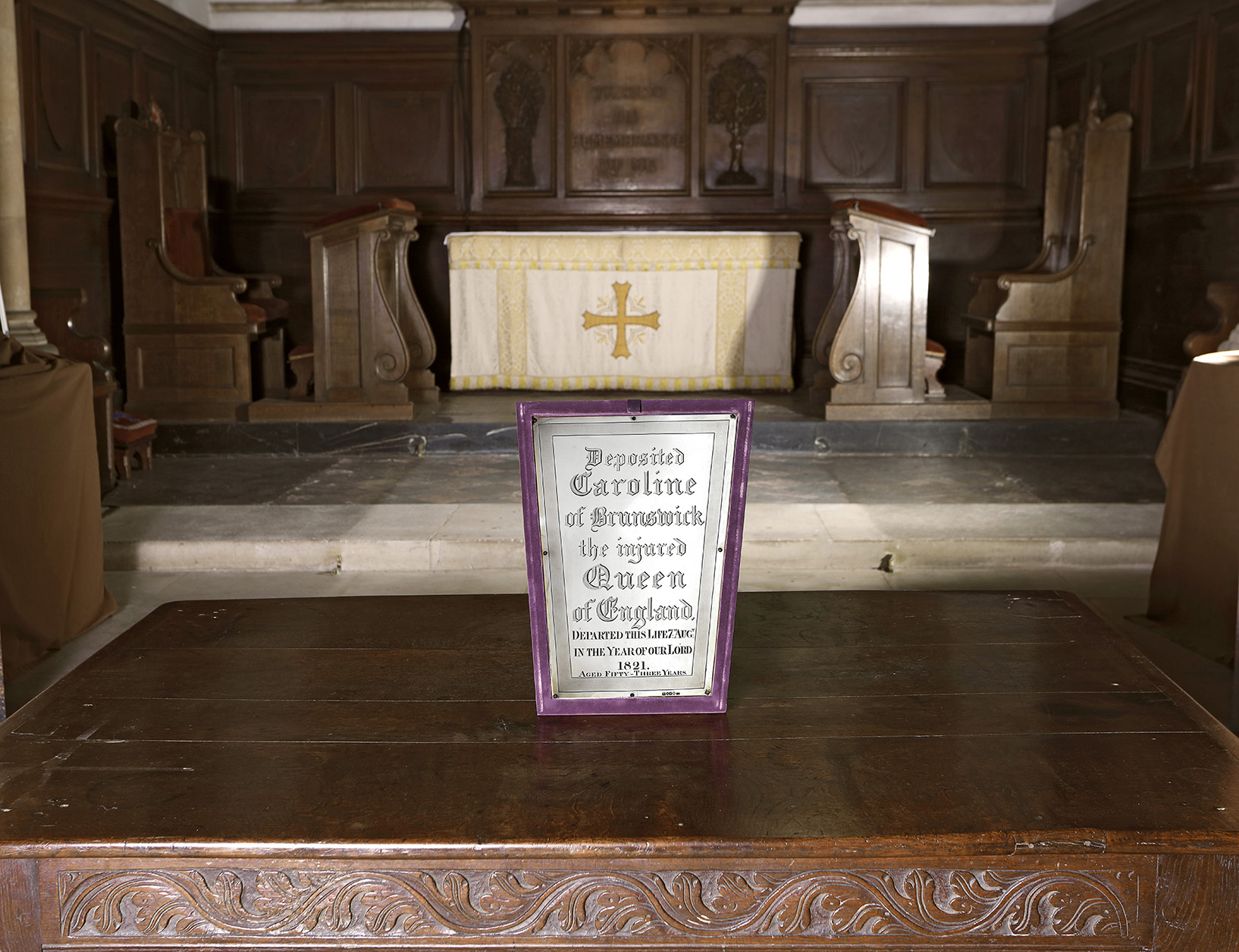
Caroline’s coffin plate returned to Colchester in 2026
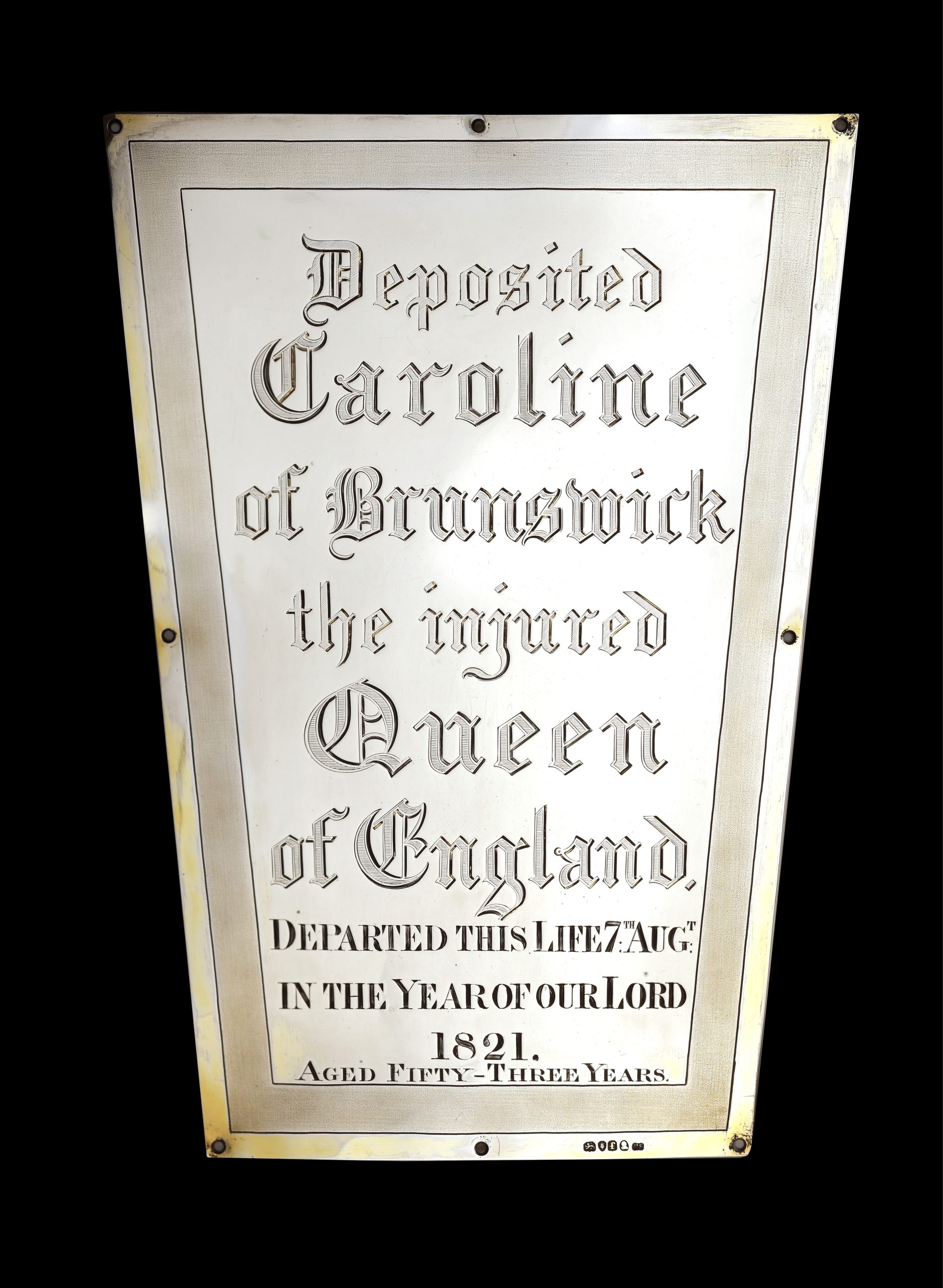
As the mourners followed the pallbearers up the church aisle, there was suddenly loud clatter as Caroline’s chamberlain and close friend Lord Hood dropped a silver coffin plate, wrapped in paper, from under his arm and onto the stone slabs. Swiftly picking it up, Hood passed the plate to Dr. Lushington who handed it to a local cabinet maker called Mr Fenton. Without further ado and at Lushington’s urging, Fenton clambered onto the table and started boring holes in the coffin to attach the plate, guarded all the while by Caroline’s household and her supporters who surrounded the coffin, talking loudly and laughing at their victory. As Caroline had wished, the plate was engraved, and in English (with her correct age):
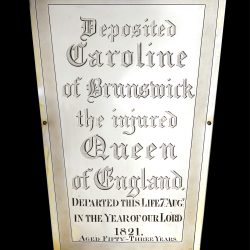
Deposited
Caroline
Of Brunswick
The Injured
Queen Of England
Departed this Life 7th: Augst:
In the Year of Our Lord
1821
Aged Fifty-Three Years
A furious argument now broke out between Lushington and officials from College of Arms and the Lord Chamberlain’s Office, who, in the name of the king, demanded that the illegitimate coffin plate should immediately be removed. As Caroline’s executor, Lushington accused them of having no authority in the matter claiming, again, that the prime minister allowed it. It was finally agreed that an express be sent back to Lord Liverpool in London for his opinion.
Eventually, the mayor of Colchester sent in troops to clear the church, and Caroline’s supporters, satisfied that the coffin plate would remain in situ, noisily returned the Three Cups. At one in the morning, however, another workman, on the order of the Lord Chamberlain’s official who was unwilling to wait for the reply from London, slipped back into the darkened church to prise off, with some difficulty, the offending coffin plate, leaving the coffin again bare and now covered in sawdust. The plate was handed to Lushington’s butler who unceremoniously shoved it down the back of his trousers between his waistcoat and coat. At dawn, as Caroline’s friends slept off their celebrations, the bedraggled cortège continued its journey to Harwich where―having been recovered from an inn at Hammersmith where it had been found hidden among some coats―the official Latin inscribed plate was restored to the coffin. At eight that evening the coffin was loaded onto a schooner for its short voyage to Cuxhaven on the coast of northern Germany. It then travelled up the Elbe to Hamburg and finally to Brunswick for its internment in the cathedral, where it remains on view today.
Meantime, Caroline’s status as a feminist icon and symbol of resistance to a patronising, abusive and hypocritical establishment, embodied by her dissolute and cruel husband, has only continued to grow, leaving her today the victor of a dispute that, for a time, threatened the very stability of George’s kingdom.
Stephen Lushington’s butler kept the coffin plate following the fracas at the church and after he died his widow hid it under her pillow. Pricked by her conscience, in 1847 she gave it back to Dr. Lushington with whose family it remained until 2025.
In 2023, the coffin plate was exhibited in ‛A Right Royal Spectacle: The Coronation of George IV’ at the Royal Pavilion, Brighton.